Kita Place in Berlin: Nobody Finds It for You

The Kita-Gutschein arrives in the post and for about a day it feels like the hard part is over. Berlin has confirmed in writing that it will pay for your child's place. Then you read the rest of the letter and work out that the state has funded a place it is not going to find for you.
The Senate says it plainly on its own Kita-Gutschein page: with your voucher you go looking for a free place in a Kita of your choice and contact them yourself. That single sentence is the whole system. A Kita place in Berlin is funded by the city and found by you, and the second half is where the year goes.

Kita Entdeckerland on Otto-Marquardt-Straße in Lichtenberg, licensed for 181 children. It is one phone call, exactly like a Kita with twenty children in a shopfront.
What the voucher gives you, and the two dates on it
From the day your child turns one, there is a legal claim to up to seven hours a day, and the Jugendamt does not test whether you need it. That is the Teilzeit level. Anything longer has to be justified by work, training or family circumstances, and the voucher records which level you were granted:
4 to 5 hours: Halbtagsförderung, and the only level that comes without lunch.
over 5 to 7 hours: Teilzeitförderung, the one you get without any needs test.
over 7 to 9 hours: Ganztagsförderung.
over 9 hours: erweiterte Ganztagsförderung.
Two dates on that voucher matter more than anything else on it.
The first is the application window. You can apply to the Jugendamt of your own district at the earliest nine months before you want care to start, and at the latest two months before. Nine months sounds generous until you notice that Kitas keep their own waiting lists on their own timetable, so the useful move is to apply on the first day the window opens.
The second is the expiry, and almost nobody knows this one. A Teilzeit voucher for up to seven hours does not expire. A Ganztags or extended Ganztags voucher does: under the Kindertagesförderungsverordnung you have to take up the place, meaning sign a contract, within seven months of the start date the Jugendamt approved. Miss that and the better voucher you argued for is the one you lose.
One more piece of Berlin housekeeping worth knowing. If your child reaches their third birthday without ever having used a Kita-Gutschein, Berlin now posts you a Willkommensgutschein without being asked. It works the same way. And the Senate's new Kita-Gutschein-Portal is meant to come online this month, which will matter mostly for adjusting a voucher you already hold.
Half of Berlin's Kitas hold fewer than fifty children
Here is where the search gets hard in a way no official page explains, and it is the reason I put the register on a map instead of writing another list of steps.
The Senate publishes the full Kita list as open data, one row per facility with its address and the number of children it is licensed to hold. Pull it apart and Berlin has 2,917 Kitas with 200,869 licensed places between them. That is a lot of capacity. It is also distributed in a way that quietly decides your odds:
The median Kita holds 48 places. Half of them are smaller than that.
958 Kitas, one in three, are licensed for fewer than 30 children. Together they hold 10 per cent of all the places in Berlin.
744 Kitas are licensed for 100 or more. Those hold 56 per cent of the places.
Those figures come from the register as it stood in November 2025, which is the current published edition, so treat any single entry as a starting point and not as this morning's truth.
So a quarter of the doors hold more than half the city. When you stand on your street and count six Kitas within ten minutes, you have counted doors, and the number you actually care about is places.
Where you live changes the shape of this before you make a single call. The average Kita in Charlottenburg-Wilmersdorf is licensed for 50.7 children. In Lichtenberg it is 104.2, and in Marzahn-Hellersdorf 99.5. The east built big Kitas next to big housing estates and most of them are still open, so Lichtenberg reaches 18,235 places out of only 175 Kitas while Charlottenburg-Wilmersdorf needs 278 Kitas to reach 14,085.

A Kreuzberg courtyard Kita off Oppelner Straße, with a Kindergärten City sign over the entrance passage. Inner-city Kitas are often tucked in behind a housing block, which is why walking past them is a bad way to find them.
My advice: weight your list towards the big houses, and do it for arithmetic reasons rather than snobbery. A Kita licensed for 250 children loses a whole cohort to school every August and has to refill it. A Kita licensed for 25 might release four places in a year, and two of those will go to siblings. Small Kitas are often lovely. They are also a much longer shot, and a list made only of them is a list that will not ring back.

A Kita signed Waldhäuschen, in an old brick villa under mature trees. A house like this is the one everybody wants, which is exactly why it should not be your whole list.
Count the places near you, not the pins
The Berlin Kita call list above is the Senate's own register drawn at real addresses. Type your postcode, or tap your actual street on the map, and it counts the doors and the licensed places inside a 5, 10, 15 or 20 minute pram walk, tells you how many of those are big houses and how many are under thirty places, and gives you each one with its address and its phone number so you can tick them off.
The number that surprises people is the spread. Around the middle of 10247 in Friedrichshain a ten-minute walk reaches about 40 Kitas and roughly 2,400 licensed places. Across the 190 Berlin postcodes in the register the total held inside a postcode runs from 60 places in 10787 near the Tiergarten up to 2,953 in 12627 in Hellersdorf, with a median of about 1,000. Two families with identical vouchers are not playing the same game.
One thing the list makes obvious once you scroll it. A lot of Berlin Kitas belong to the same few operators: the register tags 51 houses to Kindergärten City and 50 to Kindergärten NordOst, about 13,800 places between them. Each of those houses still keeps its own list and its own phone number, so treat them as separate calls. Count houses, not brands.
The thirty minutes the Jugendamt thinks are reasonable
If the Kita you wanted says no, the official route is to keep asking other Kitas, and your district Jugendamt will run a Platznachweis for you, a list of free and suitable places. Read the fine print on that service, because it sets the boundary of your search: those places can be in a neighbouring district, and a journey of up to 30 minutes by public transport counts as reasonable.
Thirty minutes on the BVG is a long way. From Hermannplatz that is most of Kreuzberg, Tempelhof and Schöneberg. It means two things at once, and they pull in opposite directions.
It means your legal claim is much harder to argue as unmet than you thought, because the city can point at a place four U-Bahn stops away and say the claim is satisfied. It also means the honest limit is not the legal one. What you will actually sustain is the walk you can do twice a day in February with a tired two-year-old and a pram, in the rain, before work. For me that is closer to fifteen minutes than thirty.
So use the wide radius for your rights and the narrow one for your list. Search out to thirty minutes when you are running out of options, and build the first call list inside the walk you will not resent.

Kita Zwergenhausen on Jablonskistraße in Prenzlauer Berg, licensed for 195 children and one of fifty houses the register tags to Kindergärten NordOst.
What it costs, and what a Kita may not ask you for
Berlin is unusual here and it is worth being precise, because people arrive expecting a bill.
Attending a Kita or Kindertagespflege in Berlin is free. What you pay is a Verpflegungsanteil of 23 euro a month towards the warm lunch, set by a Kostenbeteiligungsbescheid from the Jugendamt and paid to the provider. Berlin pays the rest. Breakfast is not inside that funding, so ask each Kita whether it offers one and on what terms. A Halbtagsplatz of four to five hours comes without lunch, and so without the 23 euro. If you receive Grundsicherungsgeld, Sozialhilfe, Kinderzuschlag, Wohngeld or Asylbewerberleistungen, the Bildungs- und Teilhabepaket can remove that contribution entirely.
Then there is the part people get pushed around on. Extra payments, Zuzahlungen, are allowed only under strict conditions:
They are always voluntary, and only for a genuine extra you asked for, such as a special organic kitchen.
A Kita may not charge for reserving a place, for admission, for a deposit, or for cleaning.
Being forced to join a Förderverein is banned.
The ceiling is 100 euro per child per month, and anything above it needs Senate approval in an exceptional case.
If you decline, your contract cannot be terminated for it and your child still takes part in everything.
If a Kita opens the conversation with a reservation fee, you have learned something useful about that Kita in the first two minutes.

A Kita playground inside a Prenzlauer Berg block. Ringing one house of a large operator does not put you on the list of the others, so count houses, not brands.
The paperwork that can still move your start date
You can have the voucher, the place and the contract and still not start on the first of the month, because the health side runs on its own clock.
Measles protection is compulsory for a Berlin Kita. A child of two or older needs two vaccinations or proof of immunity, a child of one or older needs one, and a child under one needs nothing yet but has to catch up in time. Before care begins you also have to hand in a doctor's Unbedenklichkeitsbescheinigung and proof of vaccination counselling, both from your paediatrician. Getting a paediatric appointment in Berlin at short notice is its own project, so start it when you start calling Kitas, not when you sign. If you are new to the practice queue, how specialist appointments really work here is the same set of doors, and whether you are with a statutory or private Krankenkasse changes who you can walk into.
Three more mechanics that catch people:
Signing the contract is what activates the money. The provider reports the contract to the Jugendamt, and you get a written confirmation that the place is financed.
Changing Kita keeps the voucher, but not the funding overlap. A new contract is normally only financed once the old one has ended, and notice under the Kita law may not exceed one month to the end of a month.
Leaving Berlin ends a Willkommensgutschein. Move to Brandenburg and it stops being valid. Your child can stay in a Berlin Kita if your new Brandenburg authority reimburses Berlin under the joint Staatsvertrag, and only while Berlin has enough free places. Worth thinking about before you sign anything on the far side of the Ring, and the notice you have to give on the flat runs on a separate clock again.
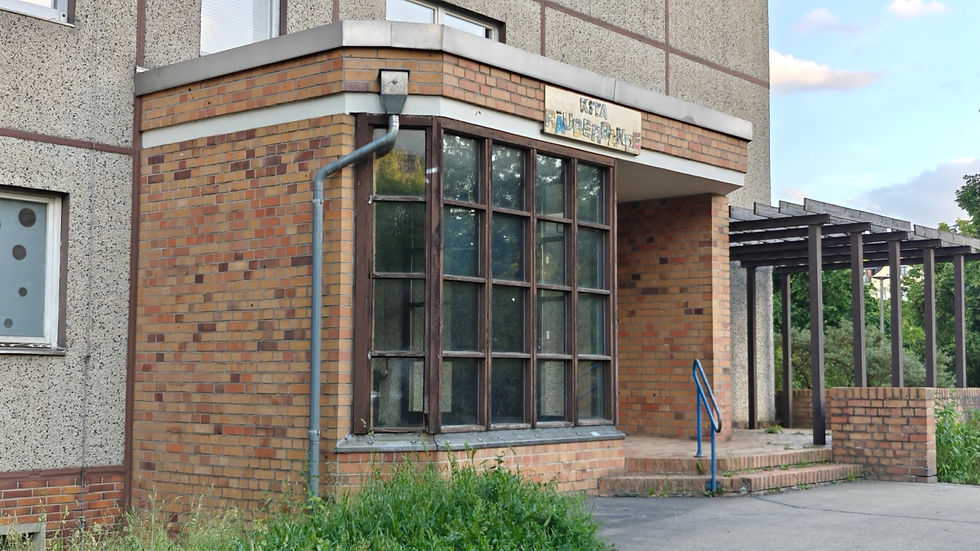
A former Kita at Ernst-Thälmann-Park. The register is a snapshot, so the November list can still send you to a door that has stopped taking children.
How I would run the search for a Kita place in Berlin
Nothing above is hard on its own. It goes wrong because the pieces run on four different clocks. So here is the order I would keep.
Apply for the voucher on the first day of the nine-month window, at the Jugendamt of the district you live in. While you wait for it, build the call list: everything inside a fifteen-minute walk, sorted biggest first, twelve to fifteen doors, and if that list is thin, widen to twenty minutes before you widen anywhere else. Ring them, one morning, in order. An email to a Kita office competes with sixty other emails and a phone call competes with whoever else rang that Tuesday.
Ask two questions on every call: can you put my child on your Vormerkung list, and roughly when do you decide for next August. Write the answer down, then ring the same list again six weeks later, because lists move when a family moves away. If you are two months out with nothing, ask your Jugendamt for the Platznachweis and be ready for it to point at the next district.
And book your paediatric appointment now. That is the one step nobody can speed up for you.
The official Kita-Navigator is the right place to read what each Kita actually does, its pedagogy and its focus, and to send an enquiry through. Use it for the judgement. Use the tool above, or any of my other free Berlin tools, for the counting.
Image credits
Source and licence details for the 5 photographs used in this article.
Kita Entdeckerland on Otto-Marquardt-Straße in Berlin-Lichtenberg: Minderbinder, CC BY-SA 4.0, via Wikimedia Commons.
A courtyard Kita off Oppelner Straße in Berlin-Kreuzberg: Gunnar Klack, CC BY-SA 4.0, via Wikimedia Commons.
Kita Zwergenhausen on Jablonskistraße in Berlin-Prenzlauer Berg: Fridolin freudenfett, CC BY-SA 4.0, via Wikimedia Commons.
A Kita playground on Christburger Straße in Berlin-Prenzlauer Berg: Fridolin freudenfett, CC BY-SA 4.0, via Wikimedia Commons.
A former Kita in a housing block at Ernst-Thälmann-Park in Berlin, 3 June 2026: Jcornelius, CC BY 4.0, via Wikimedia Commons.