Home Internet in Berlin: What Reaches Your Flat and the Rule That Cuts Your Bill

The router blinks, the contract says 250, and the laptop says 58. You restart the box, you move it off the floor, you blame the neighbours, and by the third month you have quietly accepted it. That acceptance is worth real money, because German law has given you a way out since December 2021 and almost nobody in Berlin uses it.
Here is the number that should change how you read your own bill. The Bundesnetzagentur measures fixed lines across the country and published its tenth annual report on 18 June 2026, covering October 2024 to September 2025. Of the people who measured, only 45.9 per cent reached the full download speed their contract promised. Another way to say it: more than half of measured German households are paying for a line that does not arrive.

A courtyard in Knesebeckstraße. The flat at the back and the flat at the front are on the same street address and often on very different lines.
What actually reaches your Berlin flat
Berlin is doing better than most of Germany on fibre and it is still only about half done. The Senate's own figure, published on 4 March 2026, is that 53.4 per cent of Berlin households and business premises now have fibre passing them, up 12.6 percentage points in a single year, against a federal average of 42.9 per cent. That is roughly 1.2 million connections, with more than 270,000 added in twelve months. The stated goal is city-wide fibre by 2028.
Two things follow from that, and both matter when you are picking a tariff.
Fibre passing your building is not fibre in your flat. "Homes passed" means the cable reaches the kerb or the basement. Getting it up the staircase needs the owner's permission and an appointment.
Most of Berlin can already buy gigabit without fibre. Counting coaxial cable and fibre-to-the-building together, the Senate puts gigabit availability at 96.2 per cent. For a large share of Berlin flats the fastest thing available today is the old television cable.
The honest way to check your own address is the Bundesnetzagentur's Breitbandatlas, a public register kept by the regulator with no product to sell. Provider availability checkers will happily sell you a product your building cannot carry, then tell you six weeks later.

Drums and orange ducting waiting to go into the ground. When a Berlin side street is opened up for weeks at a time, this is usually what is going in.
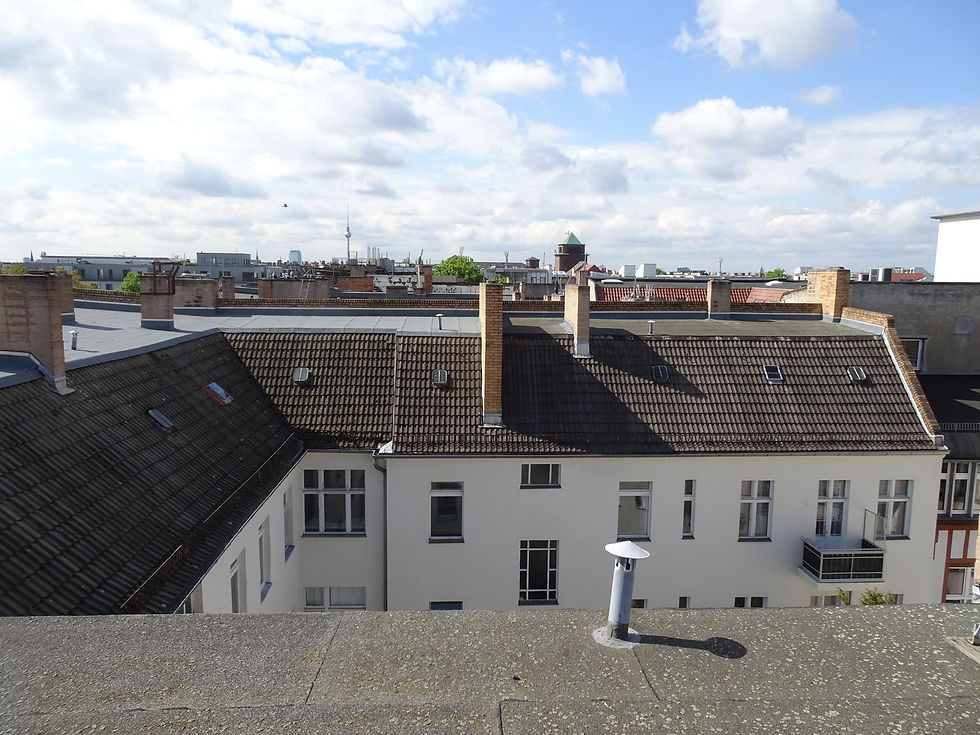
The layer the cable actually crosses. In most Berlin blocks the line comes in at the front and has to find its way to a back-building flat.
The three speeds in your contract, and why only one is advertised
Before you signed, your provider had to hand you a Vertragsinformationsblatt, a one-page contract summary. It carries three separate download figures, and the difference between them is the whole argument.
Maximum speed. The "bis zu" number. This is what the advertising shows, and it is the only one most people ever see.
Normally available speed. What the line should deliver most of the time in normal use.
Minimum speed. The floor the connection is never supposed to drop below.
Find that sheet. It is in the confirmation email from the day you signed, or in your account area under contract documents. Without those three numbers you cannot make a claim, because every legal test below is measured against them.

The physical line behind the number. A contract can promise 250 Mbit/s; the copper or glass in your street decides what turns up.
Home internet in Berlin: how to prove the line is slow
A browser speed test proves nothing to a provider, and they know it. The evidence that counts comes from one specific piece of software: the Bundesnetzagentur's own Breitbandmessung Desktop-App, downloaded from breitbandmessung.de. Run it on a computer plugged into the router by cable, with nothing else using the line.
The campaign has a shape you have to respect or the result is worthless:
10 measurements a day, on three different calendar days.
At least one clear calendar day between measurement days.
No more than 14 calendar days between the first and the last day.
At least three hours between the fifth and sixth measurement of each day, and at least five minutes between the others.
At the end you get a Messprotokoll, a signed measurement report. That report is the thing you send.
Three tests then decide whether the deviation counts as "significant, continuous or regularly recurring" in the wording of the law. The Bundesnetzagentur fixed them in its general ruling of 8 December 2021, and any single one of them is enough:
Rule one. 90 per cent of the contractually agreed maximum speed is not reached at least once on at least two of the three measurement days.
Rule two. The normally available speed is not reached in 90 per cent of the measurements.
Rule three. The minimum speed is undercut at least once on at least two of the three measurement days.
Most complaints I hear in Berlin fail the first test and pass the third without the person realising it, because they remember the good evenings and forget the Sunday afternoon when everything stalled. Put your own figures into the tool below and see which line you are actually on.
What that proof is worth
Section 57 of the Telekommunikationsgesetz gives you two rights once the measurement report is in your hand, and you choose which one to use.
You can reduce the payment. The wording is that the agreed charge is cut in the proportion by which the actual performance deviates from the agreed performance. The law sets the proportion and leaves the arithmetic to the two of you, so the figure is negotiated. On a €45 tariff delivering half of its maximum, an argument in the region of €15 to €22 a month is not unreasonable, and it applies for as long as the fault lasts.
Or you can walk out. The same section gives a right to terminate without notice, whatever is left of the minimum term. For anyone sitting on eighteen months of a contract that never worked, that is usually the more valuable of the two.
There is one more clause worth knowing, because it flips the burden. Once the breach is undisputed or you have proven it, your right to keep paying less continues until the provider proves that it is now delivering properly. The pressure moves to their side of the table.

A fibre pull in progress, photographed in Kiel. The same scene is currently repeating across half of Berlin's side streets.
Four other payments almost nobody claims
The speed rule gets the attention. These four are easier to trigger and they are ignored constantly.
The technician did not turn up. A missed service or installation appointment is worth €10 or 20 per cent of your monthly charge, whichever is higher, for each missed appointment.
The line is completely down and stays down. If a fault is not fixed within two calendar days of you reporting it, you can claim €5 or 10 per cent of the monthly charge for the third and fourth day, and €10 or 20 per cent from the fifth day, per day of full outage.
Switching provider left you offline. A provider switch may interrupt your service for at most one working day. Every further working day is worth €10 or 20 per cent of the monthly charge.
Your old provider kept billing during that gap. From the end of the old contract until the new line runs, the old provider's connection charges drop by half unless it can show the delay was your fault.
None of this is automatic. You have to write, name the day, and ask. A short mail with dates, the fault ticket number and the sentence "I am claiming the compensation under §58 TKG" does the job; Germany's whole consumer-protection architecture assumes you will ask in writing, which is the same habit that decides a Nebenkostenabrechnung dispute.
The cable line that should have left your Nebenkosten
For decades Berlin landlords billed a monthly cable television fee to every flat in the building through the service charges, whether you owned a television or not. That arrangement, the Nebenkostenprivileg, ran out with 30 June 2024. Since 1 July 2024 the monthly broadband or cable basic fee can no longer be passed to residential tenants through the Betriebskostenabrechnung, and each household contracts for itself.

One meter, one bill, one building. The shared cable fee that used to sit on every flat's service charges here has not been chargeable since July 2024.
One charge did survive, and it is legitimate. Where an operator has newly fitted the building with fibre, a Glasfaserbereitstellungsentgelt may be billed through the service charges. The limits are tight and worth checking against your statement:
at most €60 a year per dwelling
at most €540 in total per dwelling
for at most five years, extendable to nine only if five is not enough to refinance the work
above €300 of total cost, the operator has to justify the figure
If your next statement still carries a plain cable or broadband basic fee with no fibre installation behind it, object in writing within the objection period. The Bundesnetzagentur's own page on the change is the document to quote, and a Mieterverein membership pays for itself on exactly this kind of line.
When you move
Berliners move flats often, and the contract follows the person. Where the provider serves the new address, it has to carry your contract across unchanged, same term and same conditions, and the fee it charges for the move may not be higher than what it charges for a brand new connection. Where it cannot serve the new address, you can terminate with one month's notice.

Köpenicker Straße in Kreuzberg. A moved contract belongs to the address, so it is worth checking what the new building can carry before you give notice on the old flat.
Two more contract facts are useful when you sign anything new. A consumer contract may have an initial term of at most 24 months, and the provider must also offer you a version with an initial term of at most 12 months. Once the first term is over, an automatically renewing contract can be ended at any time with one month's notice, and that termination must cost you nothing. The old trap of a contract silently rolling into another full year is gone, which is the same direction of travel as the rules on your electricity tariff and on your flat's notice period.
My advice
Pick a bad week rather than a good one. If you already suspect the line, run the official campaign in the week your flat genuinely leans on it, at the hours you actually work, and let the slow Sunday evening into the data. A measurement campaign taken at 10:00 on three quiet Tuesdays will tell you your line is fine, and that is not the question you are asking.
Then do it in this order. Find the Vertragsinformationsblatt and write down the three speeds. Install the Desktop-App and start the three days. When the report comes out, read which of the three rules it meets, and send that one sentence plus the PDF to your provider, in writing, with a deadline. If the answer is a phone script about restarting the router, repeat the deadline once and then use the termination right.
It takes about a week of light attention, most of which is waiting. I have watched people spend longer than that arguing with a chat window and getting nothing, which is the part that annoys me. The measurement is boring and it is the only thing in this whole process that a provider cannot talk its way around.
Image credits
Source and licence details for the 6 photographs used in this article.
A courtyard in Knesebeckstrasse in Berlin-Charlottenburg, seen through the entrance passage: Joe Mabel, CC BY-SA 4.0, via Wikimedia Commons.
Rooftops of a Berlin block seen from a flat roof: Andreas Schlötter, CC BY-SA 4.0, via Wikimedia Commons.
A cut fibre optic cable laid beside a steel ruler: Asurnipal, CC BY-SA 4.0, via Wikimedia Commons.
Loose fibre bundles on a pavement during an installation in Kiel: Michael Brandtner, CC BY 4.0, via Wikimedia Commons.
A Berlin courtyard block with a yellow rendered facade and a tree in the yard: Wolfgang Staudt, CC BY 2.0, via Wikimedia Commons.
The apartment building at Koepenicker Strasse 184 in Berlin-Kreuzberg: Jörg Zägel, CC BY-SA 3.0, via Wikimedia Commons.