Cranes Near Berlin: Linum at Dusk, and How to Get Home Afterwards
Every autumn, somewhere around the third week of September, a sound starts drifting over the fields north-west of Spandau: a rolling, trumpeting call from thousands of birds at once. The cranes are back at Linum, and for the next six weeks tens of thousands of them fly in over one small village every evening to sleep in the wet meadows around its fish ponds.
It is one of the best free evenings you can have from Berlin, and it is very easy to get wrong. The birds come in at dusk, the last direct bus leaves before it is properly dark, and on Saturdays and Sundays this year there is no bus to Linum at all. I worked through the timetable, the sunset times and eight years of crane counts so you can pick an evening that actually works.

Cranes heading for their roost over the Kremmener Luch in mid October, a few kilometres east of Linum.
Why the cranes near Berlin all end up at Linum
The common crane breeds across Scandinavia and the Baltic and winters in France and Spain. On the way south it stops where it can feed safely by day and sleep standing in shallow water at night. The Rhinluch around Linum, part of Fehrbellin, about 40 km from the edge of Berlin, has both: harvested maize fields for the day, and flooded meadows next to the old peat-cutting ponds for the night. That makes it one of the largest crane roosts in Central Europe.
The local association that counts them, the Landschaftsförderverein Oberes Rhinluch, officially starts the season in mid September. This year the weekly counts start on Tuesday 22 September, taken in the morning as the birds fly out.
The cranes stay into November, but the numbers move a lot from week to week. These are the highest Tuesday counts at the Linum roost in recent years:
2018: 74,440 on 16 October
2019: 72,040 on 22 October
2020: 59,710 on 27 October
2021: 79,240 on 19 October
2022: 54,190 on 11 October
2023: 42,740 on 31 October
2024: at least 70,895 on 15 October, counted in fog
2025: 56,630 on 30 September
So the peak has landed anywhere between the last day of September and the last day of October, and mid October is the safest bet. In some years there were still 40,000 to 50,000 birds in the first week of November. In others there were barely 3,000.
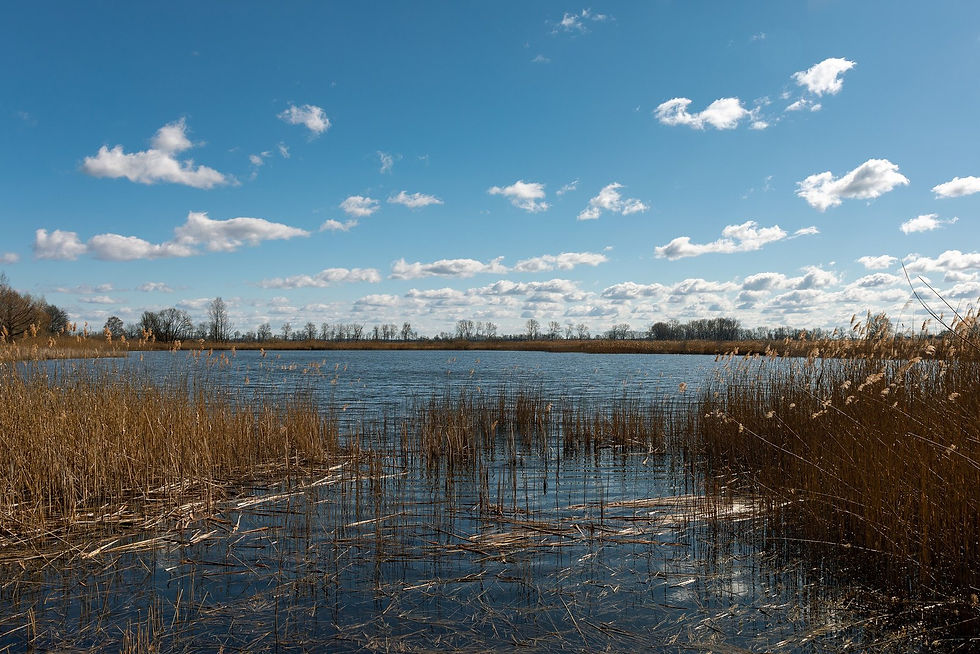
The fish ponds at Linum. The cranes do not land in the ponds themselves but in the shallow flooded meadows around them.
Last autumn, and what to check before you go
Last year is the reason for that low November number. In October an outbreak of bird flu killed hundreds of cranes at Linum. On 21 October 2025 NABU cancelled all its guided tours and asked people not to travel to the area on their own. The count dropped from 23,690 on 14 October to 6,960 a week later.
This season has opened normally so far. NABU's Storchenschmiede in Linum opened its crane season on 18 September and lists its guided tours as usual. Two rules hold whatever happens:
Never touch or move a sick or dead bird. Leave it where it is.
Check the Storchenschmiede and NABU pages on the morning you go. If there is a new outbreak, they are the first to say so.
When the cranes fly in
The fly-in happens as the light goes. The local association's rule of thumb is from about 17:00 before the clocks change and from about 16:00 after, with the birds arriving in waves until it gets dark. The clocks go back on Sunday 25 October, which shifts the whole evening an hour earlier.
For Linum, sunset falls at:
18:58 on 26 September
18:42 on 3 October
18:26 on 10 October
18:10 on 17 October
16:53 on 25 October, after the clock change
16:28 on 7 November
My plan for any evening there is to be standing in place an hour before sunset and to stay until you cannot see the birds any more. That last half hour is exactly where the transport problem starts.

A flock of cranes passing the moon on the way to the roost. Cranes call in flight, so you often hear a flock before you see it.
Plan your evening at Linum
Pick a date and how you want to get there. The planner works out sunset and dusk at Linum for that evening, shows the fly-in window, and picks the connection there and back from the autumn timetable. The second panel shows how many cranes were counted within a few days of your date in the last eight years.
A few things the planner makes very clear:
A Saturday or Sunday by bus does not work this year. The VBB timetable shows no bus to Linum at weekends or on holidays for the whole season, and the weekend crane bus of earlier years is not running. That includes 3 October.
A weekday in early October works, but not with the last direct bus. The 18:24 back to Nauen leaves before sunset. Stay for the 19:30 via Fehrbellin and Neuruppin instead and you are at Hauptbahnhof at 21:49.
After 25 October the weekday bus is perfect. Sunset is before 17:00, so the 18:24 leaves after dark and you are back at Hauptbahnhof at 19:35.
Getting there without a car
On a weekday: train and bus 758
Take the RE8 from Berlin Hauptbahnhof to Nauen and change to bus 758. The 14:25 from Hauptbahnhof gets you to Linum, Küsterstege at 15:30, which leaves time to walk around the village before the birds arrive. The later 16:25 arrives at 17:30, after the first cranes, so before the clocks change I would take the earlier one.
For the way back you have two buses:
18:24 from Küsterstege to Nauen, then the RE8, at Hauptbahnhof at 19:35
19:30 to Fehrbellin, bus 756 to Neuruppin, RE6 to Hennigsdorf and the S25, at Hauptbahnhof at 21:49
The whole trip is covered by the Deutschlandticket. If you still pay per trip, my Berlin monthly ticket guide shows when the ticket pays for itself.
At the weekend: train to Kremmen and 11 km by bike
Kremmen is the nearest station, about 11 km east of Linum. From Hauptbahnhof you take the S-Bahn to Hennigsdorf and the RE6 or RB55 on to Kremmen, about an hour in all. On the way back two trains an hour leave Kremmen for Hennigsdorf, at about ten past and ten to the hour, every day until 22:56.
The ride itself is easy and flat, about 45 minutes. Two warnings from the people who live there:
Most of the route has no cycle path. You share country roads with cars.
Everyone leaves at the same moment. When it gets dark, practically every visitor drives off at once, so you ride back in the dark next to a queue of headlights. Proper lights are not optional here. My guide to bike lights in Berlin covers what the law asks for.
The Deutschlandticket does not cover the bike. A VBB single bike ticket for the whole network is €4.60 each way, or €7.50 for a 24-hour bike ticket.

The platform at Kremmen. Two trains an hour run from here to Hennigsdorf, the last one just before 23:00.
Where to stand when they come in
The association names three good spots for the evening fly-in:
The Schöpfwerk, the pumping station, where most cranes come over and most people stand. It asks visitors to walk out along the Koppelweg that branches off there, which gives everyone more room.
Behind the village church, with a wide view, though you stand next to parked cars.
The pond area, prettier but without the wide view.
During the day the cranes feed on the fields along the Kuhhorster Weg, which turns off in the village towards Kuhhorst. There is a small car park with a blue parking sign. Take binoculars: the birds decide how close they come, and it is never very close.

The village church in Linum. The meadow behind it is one of the three spots the local association recommends for the evening fly-in.
The rules that keep the cranes coming back
The whole thing only works because the birds are left alone at night. The rules are simple and the association is blunt about them:
Never enter the nature reserve, marked with a yellow owl sign, and respect every barrier.
Do not walk onto fields or farm tracks, however far away the birds are.
Stay in cover. Sitting in the car works like a hide; out of the car, stand behind reeds or bushes.
Stand on the verge, never on the road. Stopping on a priority road outside the village is not allowed; if you do stop, pull fully onto the verge.
Keep out of the way of farm machinery. The harvested fields are the reason the cranes come.
If you see the whole flock suddenly lift their heads, they have noticed someone. Take a few steps back and wait.

A crane looking for leftover grain on a harvested field in Brandenburg. By day they spread out over the fields around Linum and feed for hours.
A guided evening at the Storchenschmiede
If you would rather go with someone who knows the birds, NABU's Storchenschmiede at Nauener Straße 54 runs guided evening fly-in tours of about 90 minutes for €10 (€8 for NABU members and children under 12), and morning tours for €12. Booking is required for all tours, by phone, email or in person. In the crane season, 18 September to 1 November, the exhibition is open Friday to Sunday from 11:00 until an hour after sunset. Bring dark clothes, proper shoes and binoculars if you have them.
A weekend tour still leaves you with the same transport question, so plan it as a Kremmen bike trip or book a weekday.
The move I would make
Pick a weekday evening in the second or third week of October, when the numbers have historically been highest and there are fewer people than at the weekend. Take the 14:25 from Hauptbahnhof, walk out along the Koppelweg an hour before sunset, and stay for the 19:30 bus home. If a weekend is the only option, take the bike to Kremmen and charge the lights before you leave.
Wrap up warm. An October evening standing in the Rhinluch is colder than it looks from the S-Bahn window. If you like this kind of Saturday, my guides to mushroom picking around Berlin and the Berlin hiking trails are the next two I would open.
Image credits
Source and licence details for the 6 photographs used in this article.
Cranes flying over the Kremmener Luch at sunset: MT09CHR, CC BY-SA 4.0, via Wikimedia Commons.
The fish ponds at Linum: MT09CHR, CC BY-SA 4.0, via Wikimedia Commons.
A flock of cranes passing the moon over the Kremmener Luch: MT09CHR, CC BY-SA 4.0, via Wikimedia Commons.
A crane searching for grain on a stubble field in Brandenburg: Andreas Weith, CC BY-SA 4.0, via Wikimedia Commons.
The village church in Linum: Hans G. Oberlack, CC BY-SA 4.0, via Wikimedia Commons.
The platform at Kremmen station: Dirk Ingo Franke, CC BY-SA 4.0, via Wikimedia Commons.