The Most Beautiful U-Bahn Stations in Berlin: Which Ones Are Worth Getting Off At

Berlin's U-Bahn is a machine for getting somewhere else. You come down the stairs, the train arrives, you get on, and almost nobody looks up. That is a sensible habit on most of the network and a wasteful one at about a dozen stations, where the platform was built as a room: vaulted ceilings, glazed tile, lamps chosen by an architect who assumed people would be standing there.
Three of the best are within four minutes of Alexanderplatz. One of them is directly under a stop on my walking tour.

Museumsinsel on the U5, three minutes from Alexanderplatz. The vault carries 6,662 points of light.
My advice: pick two, and treat them as a detour inside a day you were already having. The stations worth seeing are scattered from Mitte to Spandau, and the far ones are a forty-eight minute ride in each direction. Two of them, chosen because they are near something else you wanted to do, is a good hour underground. Thirteen of them is a day spent reading connection times on a phone.
Three of them are already under your feet
The U5 extension opened on 4 December 2020 and put three new stations under the historic centre. If you are walking Unter den Linden or Museum Island, you are walking over all three.
Museumsinsel is the one to see first. The platform sits 16 metres down under the Spreekanal, and the ceiling is a deep blue barrel vault carrying 6,662 points of light. Max Dudler took the idea straight from Karl Friedrich Schinkel's 1816 stage set for The Magic Flute, which was designed for a theatre a few hundred metres from where you are standing. It opened seven months after the rest of the line, on 9 July 2021, because building it needed the ground under the canal frozen solid first.
Rotes Rathaus is the one with the story. Seven mushroom-head supports, each roughly 7 by 9 metres, hold up the whole ceiling so the hall can stay open, and the cap shape is a deliberate echo of the vault in the medieval town hall that stood on this exact spot. Archaeologists found its foundations when the shaft was dug in 2009. A window down to those remains was planned and has stayed closed for cost reasons, so do not go expecting to see the excavation itself.

Rotes Rathaus, one minute from Alexanderplatz on the U5. The white forms overhead are the caps of seven columns.
Unter den Linden is the plain one, and you will use it anyway. It is the U5 and U6 interchange, pale and wide, and it takes two minutes of attention while you are changing trains. The other two deserve a stop of their own.
On my free walking tour, the route crosses over Rotes Rathaus station near the start and over Museumsinsel in the middle. If you want to look at either properly, do it before 11:30 or after the walk ends at Hackescher Markt.
Klosterstraße: a piece of Babylon, one stop from Alexanderplatz
Take the U2 one stop east from Alexanderplatz and you reach a station that opened on 1 July 1913 to plans by Alfred Grenander, the architect who shaped most of the early network.
The entrances carry stylised palms in orange, blue and white glazed tile. They were made with the same brick technique used for the Ishtar Gate in the Pergamon Museum, from tiles left over when the gate itself was assembled. The originals that survive are in the south entrance, majolica from Cadinen in East Prussia.
That detail matters more than usual right now. The Pergamon Museum has been completely closed since October 2023, and the Ishtar Gate is not expected back on display until the 2030s. Klosterstraße is currently the closest you can get to that ceramic in Berlin, and it costs nothing beyond the ride.

Klosterstraße on the U2. The framed panels along the wall are the 1986 transport history series.
The platform itself was rebuilt between 1984 and 1986 for Berlin's 750th anniversary and turned into a small museum you walk through:
22 enamel panels showing the development of Berlin public transport through its vehicles, installed in 1986
The front section of Triebwagen 12, a Schöneberg subway car from 1910, restored and parked at the platform end
An original mechanical signal box from the elevated railway, behind glass at the southern end
If underground leftovers are your thing, the Berlin ghost stations story sits in the same part of the network.
The 1913 stations that need a real detour
West of the centre there is a run of stations from Berlin's first great building decade. They are 19 to 30 minutes out on the U2 and U3, so each one is a decision about your afternoon.
Wittenbergplatz has the best entrance hall on the network. Grenander built a cross-shaped ticket hall above ground in 1913 to match the scale of KaDeWe across the square. It is a listed building, restored in 1982 and 1983, and it still has wooden ticket kiosks standing in the middle of the floor and historic advertising panels along the walls. Nineteen minutes from Alexanderplatz on the U2, and you are already at the top of the Ku'damm shopping axis.

The wooden kiosks inside Wittenbergplatz. The hall is protected as a historic monument.
Heidelberger Platz is the one people photograph. Wilhelm Leitgebel opened it on 12 October 1913 with a cross-groin vault on stone piers and lamps hanging on long chains. The district of Wilmersdorf paid for stone supports instead of the usual steel, which is the whole reason it reads as a church rather than a tunnel. It is 28 minutes out on the U2 then U3, so go when you have a reason to be in the west anyway.
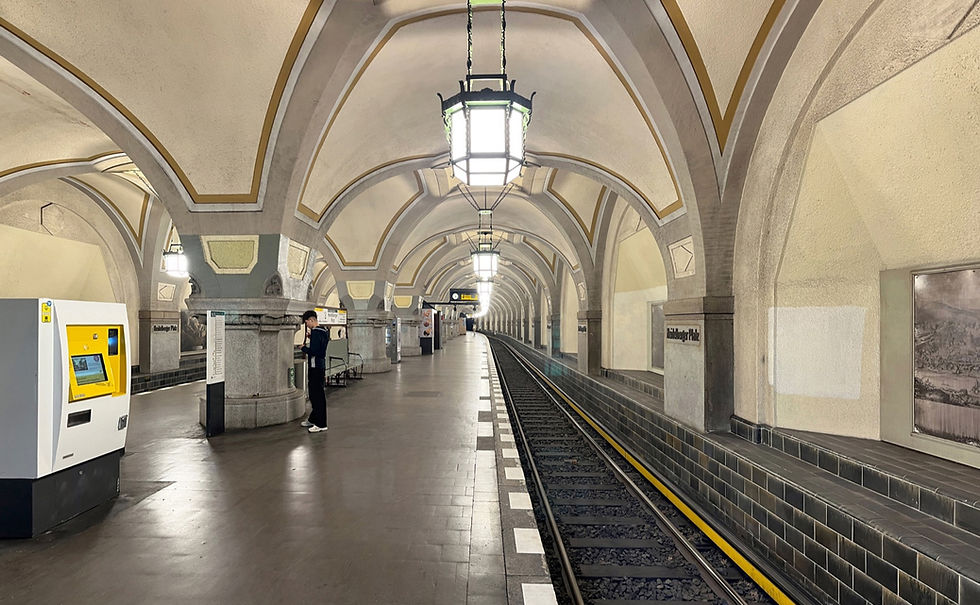
Heidelberger Platz on the U3. One stop before Rüdesheimer Platz, which Leitgebel also built.
Two more on the same line:
Rüdesheimer Platz, U3, 30 minutes out. Leitgebel again from the same October 1913 opening, with granite columns and mosaic work. Come up the stairs for the Rheingauviertel wine square above it.
Fehrbelliner Platz, U3 and U7, 26 minutes out. Two eras stacked in one station: Leitgebel's 1913 platform below, and Rainer G. Rümmler's 1971 entrance pavilion above, all rounded corners and red-framed signs.
The U7 to Spandau costs a half day, and Spandau is the reason to go
Between 1980 and 1984 the U7 was pushed west through Siemensstadt into Spandau, and Rümmler designed every station on it. He was criticised at the time for being far too colourful for a piece of public infrastructure, which is exactly why people now travel out to see them. visitBerlin lists the whole run as a piece of city architecture.
Rohrdamm, opened 1 October 1980: stylised cogwheels and machine parts, for the Siemens factory district above
Paulsternstraße, 1984: a wall of tile flowers and a rainbow on deep blue, with purple and yellow columns around the benches
Zitadelle, 1984: red brick answering the 16th-century fortress walls directly overhead
Altstadt Spandau, 1984: white-clad columns set close together, deliberately cathedral-like
Rathaus Spandau, opened 1 October 1984: two island platforms at almost monumental scale, black granite piers with green and gold above them, and a gallery at the south end you can stand on and look down the whole station

Rathaus Spandau, the western end of the U7 and 48 minutes from Alexanderplatz.
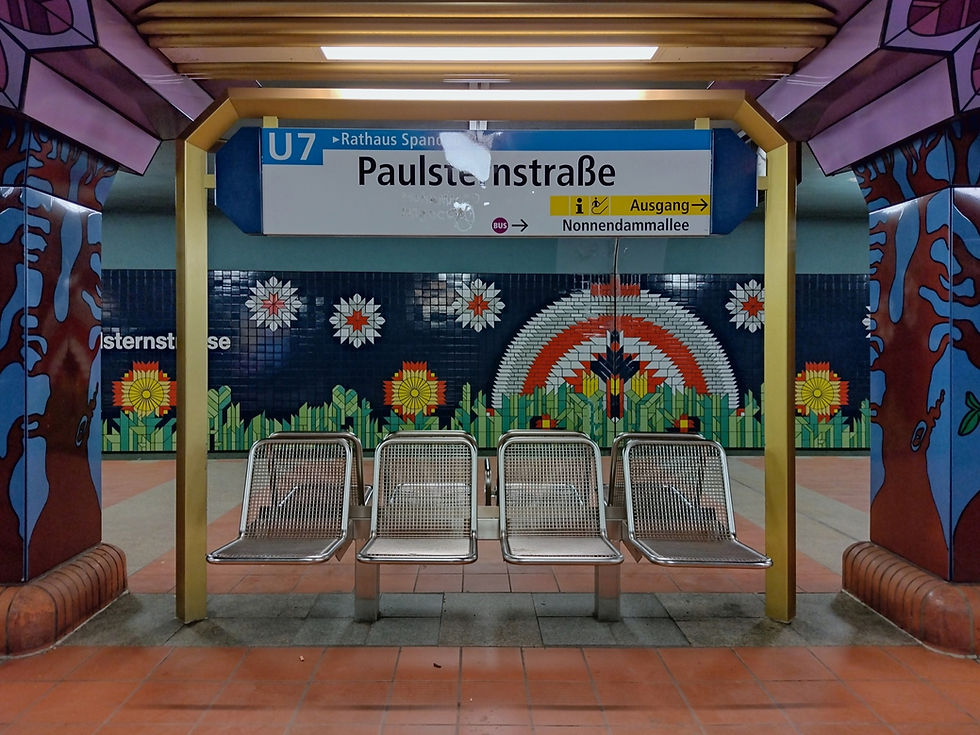
Paulsternstraße, two stops before Spandau. Rümmler was told this was too much for a railway station.
Forty to forty-eight minutes each way is a genuine trip, so make the ride the smaller half of the day. Spandau's old town is a walkable medieval core with a citadel next to it, and the last five stations of the U7 are simply what you look at on the way in.
How to fit the most beautiful U-Bahn stations in Berlin into the time you have
Riding time is the thing that decides this, not interest. Set the board below to the minutes you can actually spend on trains, and it shows you which stations fall inside that line and adds up a real total as you pick them.
The plot underneath is worth a second look on its own. Berlin built beautiful stations in three short bursts, in 1913, in the early 1980s and again in 2020, with almost nothing in between, and the newest ones happen to be the closest to where most visitors already stand.
The ticket this actually needs
All thirteen stations sit inside the AB zone, so one ticket type covers the whole exercise. The question is which one.
A single AB ticket is €4.00 and runs for 120 minutes, but only in one direction. Return journeys are not allowed on it, so an out and back needs two.
A 24-hour AB ticket is €11.20. It pays for itself the moment you are heading to more than one corner of the city, or combining this with anything else.
So: one out and back to a single area, two singles at €8.00. Museum Island in the morning, Spandau in the afternoon, day ticket. Prices checked on 26 August 2026 against BVG's own ticket pages, and they moved in January, so check before you assume.
Buy from a machine on the platform or in the BVG app, and remember that a paper ticket has to be stamped in the small red or yellow box before you board. That trips up more visitors than anything else on the network, and it is covered properly in the Berlin public transport guide.
Looking at a station without getting in the way
A platform is a working space, and a few small habits keep this pleasant for everyone:
Go between 10:00 and 15:00. Outside the rush the platforms are half empty, the light is steady and nobody is trying to get past you.
Stand behind the tactile strip. The ribbed paving near the edge is a guidance line for blind passengers, not a photo mark.
Leave the tripod at home. BVG does not allow tripods, lights or flash rigs on its stations, and anything commercial needs written permission from the company first. A phone snapshot on a quiet platform is what everyone actually does.
Come up and out where it makes sense. Wittenbergplatz opens onto KaDeWe, Zitadelle onto the fortress, Rüdesheimer Platz onto a wine square. The station is rarely the whole reason.
Check the exit before you climb. Several of these have four or five street exits, which is its own small puzzle at Berlin's larger stations.
If you want a version of this in daylight, the historic centre above Rotes Rathaus and Museumsinsel is the ground my walking tour covers: eleven stops, sixteen places, about 3 km, roughly 2 hours. The medieval town hall whose vault gave Rotes Rathaus station its column shape stood a few metres from where the group gathers.
Image credits
Source and licence details for the 7 photographs used in this article.
The starry blue vault over the platform at Museumsinsel U-Bahn station: Andrzej Otrębski, CC BY-SA 4.0, via Wikimedia Commons.
A U5 train passing the platform at Rotes Rathaus U-Bahn station: Tim Rademacher, CC BY-SA 4.0, via Wikimedia Commons.
The platform and transport history panels at Klosterstraße U-Bahn station: Clemensfranz, CC BY-SA 4.0, via Wikimedia Commons.
Wooden ticket kiosks inside the 1913 entrance hall at Wittenbergplatz: Pymouss, CC BY-SA 4.0, via Wikimedia Commons.
The vaulted platform hall at Heidelberger Platz U-Bahn station: Gunnar Klack, CC BY-SA 4.0, via Wikimedia Commons.
The platform at Rathaus Spandau U-Bahn station: Gunnar Klack, CC BY-SA 4.0, via Wikimedia Commons.
The tiled flower mosaic on the platform wall at Paulsternstraße U-Bahn station: Bildarbeiter, CC BY-SA 4.0, via Wikimedia Commons.