12 Stops Through Berlin’s Ancient Core: What You’ll See on My Free Walking Tour
Updated: Sep 6

Most Berlin free walking tours start at the Brandenburg Gate and head west. My tour doesn't.
I begin where Berlin itself began — at Alexanderplatz — and walk through the oldest neighborhoods in the city, ending at the vibrant Hackescher Markt. Over 12 carefully chosen stops, you'll trace 800 years of history through streets that most tourists never explore.
This isn't a greatest-hits tour of famous landmarks. It's a walk through the layers of Berlin — from its medieval founding to Prussian ambition, from communist ideology to reunification. Each stop tells a story, and together they paint a picture of a city that has reinvented itself more times than any other capital in Europe.
Here's what you'll see — stop by stop.
The Route at a Glance
Start: Alexanderplatz (World Clock)End: Hackescher MarktDistance: ~3 kmDuration: ~2hStops: 12Terrain: Flat, paved, easy walkingCost: Free (tip-based) |
The route moves roughly west from Alexanderplatz, through the historic Nikolaiviertel area, across Museum Island, and ends in one of Berlin's best neighborhoods for food and nightlife. It's designed so that every stop builds on the previous one — by the end, you'll understand how Berlin became the city it is today.
Stop 0: Alexanderplatz — Where It All Starts
This is where I meet you: at the World Clock (Weltzeituhr) in the center of Alexanderplatz.

Today, Alexanderplatz is a busy transit hub — loud, chaotic, and honestly not the prettiest square in Berlin. But that's part of the story. This square has been a medieval cattle market, a Prussian military parade ground, a Weimar-era department store district, a bombed-out ruin, and a showcase of GDR urban planning. No single place in Berlin has changed identity more often.
I use Alexanderplatz to set the scene: what Berlin looked like 800 years ago, how the city grew, and why the eastern half of the city center looks so different from the west.
For practical details on getting here from the airport, check my BER to Alexanderplatz transport guide.
Stop 1: Rotes Rathaus — Berlin's Medieval Roots
A 3-minute walk from Alexanderplatz brings you to the Rotes Rathaus (Red City Hall) — Berlin's seat of government since the 1860s.

The name "Red" has nothing to do with communism. It refers to the red bricks the building is made from. This is where I tell the story of Berlin's founding — how two small medieval trading towns, Berlin and Cölln, merged and grew into a capital city.
The terracotta frieze running around the building tells Berlin's entire history in 36 panels. Most people walk past without noticing it. I don't.
Stop 2: Neptune Fountain & TV Tower — The Pope's Revenge
Two landmarks, one stop — and one of the best stories on the tour.

The Neptune Fountain (Neptunbrunnen) was originally built for a completely different location. The mythological figures represent four rivers — none of them in Berlin. It ended up here almost by accident.
But the real star is behind it: the TV Tower (Fernsehturm). At 368 meters, it's the tallest structure in Germany — built by East Germany in the late 1960s as a symbol of communist technological superiority.

The irony? When the sun hits the steel sphere, a glowing cross appears on the dome. In an officially atheist state. Berliners called it "die Rache des Papstes" — the Pope's Revenge. The GDR tried everything to fix it. They never could.
For the full story, read my post on the Pope's Revenge and how East Germany's TV Tower backfired.
Stop 3: St. Mary's Church — 700 Years of Survival
St. Mary's Church (Marienkirche) is one of the oldest churches in Berlin — dating back to the late 13th century. It's also one of the very few medieval structures that survived World War II bombing largely intact.

Inside, there's a 22-meter medieval fresco called the Totentanz (Dance of Death) — a haunting painting from around 1484 that depicts Death dancing with people from every walk of life. It was painted after a plague devastated the city.
The church is free to enter and is an active Protestant parish. It's a quiet, contemplative moment in the middle of a busy tour.

Stop 4: Marienviertel — Berlin's Oldest Quarter
This is the stop that surprises people most.

Marienviertel is what remains of Berlin's original medieval city — the area where Berlin was literally born. Most tourists rush past it because there's nothing flashy here. No Instagram-famous landmarks. No crowds.
But if you look carefully, you'll find traces of the medieval street layout, foundations that predate the Reformation, and a sense of scale that reveals just how small Berlin once was. This is where a village became a city.
I use this stop to explain what GDR urban planning did to Berlin's medieval center — how entire neighborhoods were demolished to make way for socialist-realist architecture — and what survived.
Stop 5: Marx-Engels-Forum — Ideology in Stone
The Marx-Engels-Forum is an open park between Alexanderplatz and the Spree River, dominated by the bronze statues of Karl Marx and Friedrich Engels.

There's a famous joke about these statues: after reunification, Berliners said "turn them around so they can face capitalism." It captures Berlin's relationship with its own history — irreverent, self-aware, and always a little dark.
I use this stop to talk about how the GDR shaped this entire area — demolishing medieval Berlin and rebuilding it as a showcase of communist ideology. The empty space around the statues isn't accidental. It was designed to feel monumental.
Stop 6: Liebknecht Bridge — The Best View on the Route
This is the photo stop.

From Liebknecht Bridge (Karl-Liebknecht-Brücke), you get one of Berlin's most iconic views: the Berliner Dom on one side, the Humboldt Forum on the other, with the Spree River flowing between them and the TV Tower rising behind.
Two buildings separated by centuries of ambition — a Prussian cathedral built to rival the Vatican, and a reconstructed palace that took €680 million and decades of controversy to rebuild. Standing on this bridge, you can see them both at once.
This is the shot that ends up on postcards. Sunset is the best time for photography, but it's beautiful at any hour.
For more on the view and the bridge's history, check my post on Friedrichsbrücke — the quiet bridge that tells Berlin's entire story.
Stop 7: Humboldt Forum — Berlin's Most Controversial Building
The Humboldt Forum is Berlin's newest cultural center — a rebuilt Prussian palace housing museums, exhibitions, and one of the most heated debates in modern German culture.

The short version: the original Prussian palace (Stadtschloss) stood here for centuries. The GDR demolished it in 1950 and built the Palast der Republik (a modernist parliament). After reunification, Germany demolished that and rebuilt the original palace facade. Cost: €680 million.
Is it a celebration of Prussian heritage? A colonial monument? A world-class museum? Berliners can't agree. That's what makes it such a great stop — there's no easy answer.
The permanent exhibitions are free. It's worth visiting after the tour. Read my full guide: Humboldt Forum Berlin — Free Entry, Big Controversy.
Stop 8: Berliner Dom — Prussian Grandeur
The Berliner Dom (Berlin Cathedral) is impossible to miss — a massive green dome sitting at the heart of Museum Island.

Kaiser Wilhelm II built it in 1905 as a Protestant answer to St. Peter's Basilica. The dome you see today is actually smaller than the original — it was rebuilt at reduced height after WWII bombing destroyed much of the building.
Beneath the cathedral lies the Hohenzollern Crypt with over 90 royal coffins. The dome climb (270 steps) offers panoramic views that rival the TV Tower — at a fraction of the price.
Entry is €9 and includes the dome, the crypt, and the main church. For the full breakdown of what's inside: 7 Things Most Tourists Don't Know About the Berliner Dom.
Stop 9: Altes Museum — Neoclassical Perfection
The Altes Museum is the building that started Museum Island. Designed by Karl Friedrich Schinkel in 1830, its 87 Ionic columns and perfectly proportioned rotunda make it one of the finest neoclassical buildings in Europe.
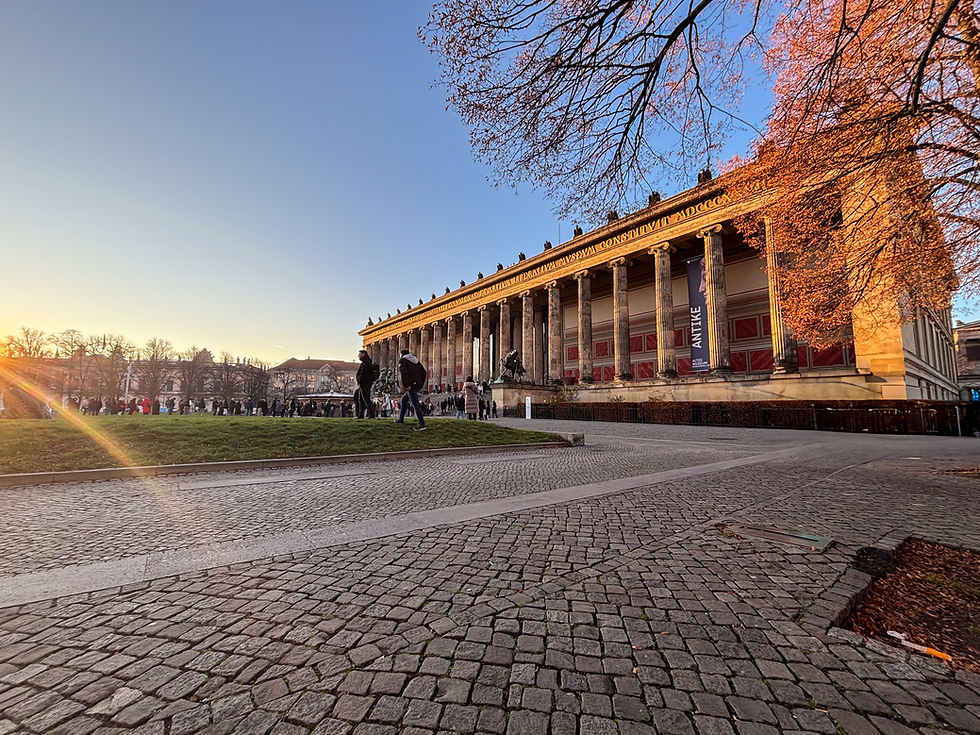
Inside: Greek and Roman antiquities. Outside: the Lustgarten — the park in front of the Berliner Dom that was once a royal kitchen garden, then a military parade ground, then a GDR rally site, and is now a public park where Berliners sunbathe in summer.
Single ticket: €14. Or get the Museum Island day pass for €25 if you plan to visit more than one museum.
Stop 10: Alte Nationalgalerie & Neues Museum — UNESCO World Heritage
I'm now deep inside Museum Island (Museumsinsel) — a UNESCO World Heritage Site and one of the most important museum complexes in the world.

The Alte Nationalgalerie looks like a Greek temple perched on a pedestal. Inside: Caspar David Friedrich, Monet, Renoir, and one of Europe's best collections of 19th-century art. Read about its full history: The Greek Temple on Museum Island That Almost Disappeared.
Next to it, the Neues Museum houses the famous Nefertiti bust — one of the most recognized artifacts in the world. The museum itself, rebuilt by architect David Chipperfield, beautifully blends war-damaged original walls with modern additions.
For ticket options and which museums to prioritize, check my Museum Island tickets guide.
Stop 11: Friedrichsbrücke — Where the River Tells the Story
Friedrichsbrücke is one of the oldest bridge crossings in Berlin. From here, you get a sweeping view of the Spree River, the Bode Museum at the tip of Museum Island, and the surrounding historic architecture.

This is a quieter, more reflective stop. The bridge has been destroyed and rebuilt multiple times — just like the city around it. I use this moment to bring the tour's themes together: destruction, rebuilding, and the layers of history visible from a single spot.
It's also a great photography spot — especially for the Bode Museum reflected in the water during calm mornings.
Stop 12: Hackescher Markt — Where the Tour Ends and Berlin Begins
The tour ends at Hackescher Markt — and this is deliberate.

Hackescher Markt is one of Berlin's most vibrant squares, surrounded by restaurants, bars, independent shops, and the famous Hackesche Höfe (a complex of eight interconnected courtyards with Art Nouveau architecture, galleries, and cafés).
This is where I say goodbye — but it's also where many visitors' real Berlin experience begins. Grab lunch, explore the Höfe, or use it as a launching point for Prenzlauer Berg, Kreuzberg, or the Scheunenviertel neighborhood.
After the tour, you're not stranded in the middle of nowhere. You're in the heart of one of Berlin's best neighborhoods.
Practical Information
Meeting point: World Clock (Weltzeituhr), Alexanderplatz
Duration: ~2 hours
Distance: ~3 km (flat, paved)
Language: English
Cost: Free — tip-based. No fixed price. Tip what you feel it was worth.
What to bring: Comfortable shoes, water (especially in summer — check my guide to free drinking water in Berlin), and a charged phone for photos.
Weather: I run rain or shine. In winter, dress warmly — I'm outside for the full duration. For season-by-season advice, see my post on the best time to visit Berlin.
Getting there: Alexanderplatz is served by U2, U5, U8, S5, S7, S75, and multiple tram lines. Coming from the airport? Check my BER to Alexanderplatz transport guide.
Accessibility: The route is flat and fully paved. No stairs (except optional Berliner Dom dome climb after the tour).
Book Your Spot on My Berlin Free Walking Tour
This tour fills up — especially in peak season. Booking in advance guarantees your spot.
📍 Alexanderplatz, World Clock
⏱ ~2 hours | 🚶 ~3 km | 💰 Free (tip-based)
Follow me on Instagram: @berlinwalkingtour